
Juvelook vs Potenza are the two most powerful non-surgical treatments for achieving a smooth, refined complexion when tackling stubborn enlarged pores in Seoul. In the realm of advanced dermatology, achieving a ‘poreless’ complexion requires a sophisticated understanding of skin physiology. Enlarged pores are not a monolithic issue; they are symptomatic of distinct underlying biological mechanisms. At view skin clinic, our clinical approach begins with a differential diagnosis between ‘Sebaceous Pores’ and ‘Elasticity-based Pores’.
Identify Your Pore Type: Are Your Pores Oily or Sagging?
Pores are the openings of the pilosebaceous units. Understanding what drives pore dilation is crucial for selecting the right treatment protocol.
Why Do Pores Enlarge? Sebum Overload vs. Collagen Loss
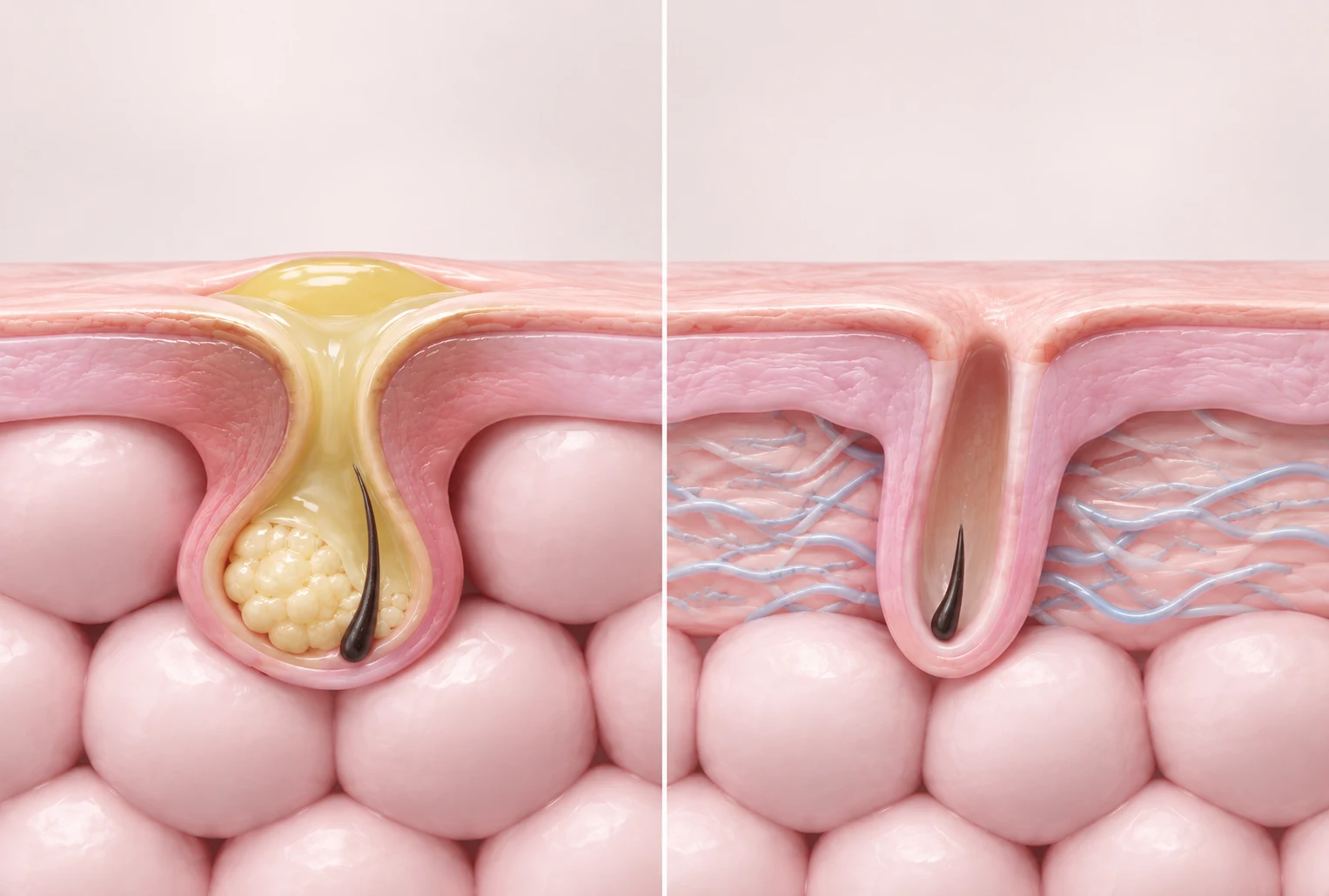
Pores are the openings of the pilosebaceous units. When sebum production is excessive (often due to hormonal fluctuations or hyperactive sebaceous glands), the follicular wall stretches to accommodate the volume, resulting in visible enlargement. Conversely, as we age, the degradation of Type I and Type III collagen, along with the fragmentation of elastin fibers, leads to a loss of structural integrity. This causes the pore to lose its circular shape and elongate into an oval or ‘tear-drop’ shape, commonly referred to as sagging pores.
Understanding these drivers is crucial. For sebum-dominant pores, the objective is to suppress the sebaceous gland activity using technologies like RF Microneedling. For elasticity-dominant pores, the goal is to rebuild the dermal matrix via bio-stimulators like Juvelook.
How They Work: Inside the Science of Juvelook and Potenza
Choosing between Juvelook and Potenza involves analyzing how each modality interacts with the dermal layers. Both are top-tier pore reduction treatments, but they operate through radically different biological pathways.
Juvelook (PDLLA + HA) : Plumping Pores from Within with Natural Collagen
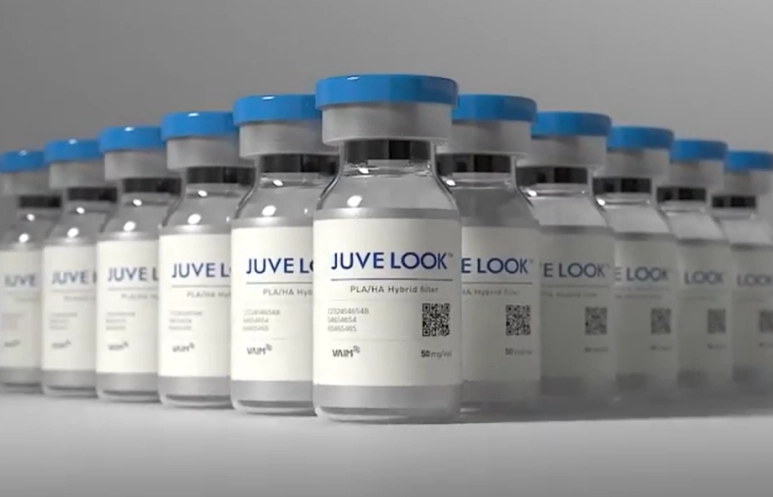
Juvelook is a hybrid skin booster combining Poly-D, L-Lactic Acid (PDLLA) with Hyaluronic Acid (HA). Unlike traditional fillers that provide immediate mechanical volume, Juvelook acts as a scaffold. Once injected into the deep dermis, the PDLLA micro-particles trigger a controlled sub-clinical inflammatory response, recruiting macrophages that stimulate fibroblasts to synthesize new endogenous collagen.
- Molecular Structure: The porous circular structure of PDLLA allows for stable collagen ingrowth.
- Target: Structural rejuvenation of the ‘Butterfly Zone’ where skin thinning is most prominent.
- Benefit: Long-term tightening of the pore wall from within.
Potenza (RF Microneedling): Shrinking Oil Glands and Resurfacing Skin Texture
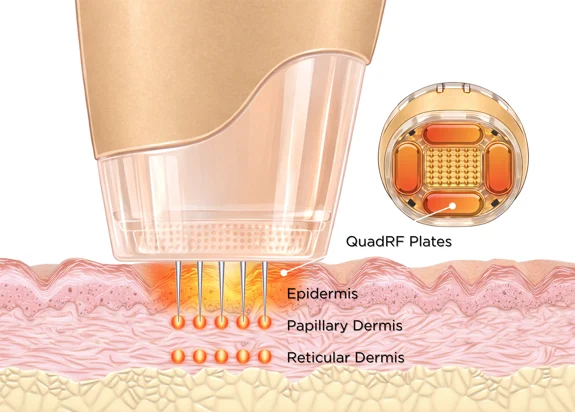
Potenza utilizes ultra-fine needles to deliver bipolar or monopolar radiofrequency (RF) energy directly into the target depth of the skin. This dual-action approach—mechanical micro-injury and thermal coagulation—induces a wound-healing response.
- Thermal Coagulation: The RF energy denatures old collagen and shrinks sebaceous glands, directly reducing oil production.
- Mechanical Remodeling: The micro-needling component breaks down scar tissue and tightens the follicular openings.
At-a-Glance Comparison: Juvelook vs Potenza
| Feature | Juvelook (Skin Booster) | Potenza (RF Microneedling) |
|---|---|---|
| Mechanism | Bio-stimulation (PDLLA) | Electro-thermal coagulation |
| Primary Target | Collagen regeneration/Volume | Sebum control/Skin resurfacing |
| Best For | Sagging, tear-drop pores | Oily, textured, acne-prone skin |
| Recovery | Minimal (1-2 days swelling) | 2-3 days redness/micro-crusts |
The Quadessy Advantage: Taking RF Microneedling to the Next Level
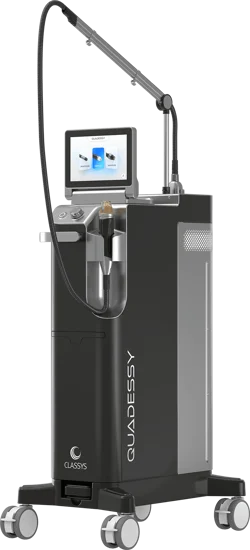
While Potenza is a gold standard, View Skin Clinic utilizes the Quadessy system to push the boundaries of RF Microneedling with Juvelook. Quadessy represents the next evolution in RF technology, offering unprecedented precision in energy delivery and needle depth control.
The Quadessy Advantage
The Quadessy Skin Tightening Guide emphasizes its superior ability to act as a drug delivery system. By using specialized ‘pump tips,’ Quadessy creates temporary micro-channels while simultaneously delivering RF energy. This creates a vacuum effect that pulls Juvelook deep into the dermis more effectively than manual injection alone.
- Precision Energy: Quadessy monitors real-time skin impedance, adjusting energy output to prevent epidermal burns while maximizing dermal remodeling.
- Synergistic Delivery: The combination of thermal heat (Quadessy) and bio-stimulatory particles (Juvelook) creates a 1+1=3 effect, where the heat accelerates the metabolic activity of fibroblasts already being stimulated by the PDLLA.
Target Zone Guide: Butterfly Zone Pore Laser Solutions
Strategic treatment planning requires segmenting the face into zones. The Butterfly Zone (the area spanning the bridge of the nose and the adjacent cheeks) and the T-Zone (forehead and chin) exhibit different pore characteristics.
Managing the T-Zone
The T-zone is typically characterized by high sebaceous density. Here, the Quadessy’s RF energy is paramount. By targeting the 1.0mm to 1.5mm depth, we can effectively cauterize hyperactive sebaceous glands, leading to a visible reduction in pore size and shine.
Restoring the Butterfly Zone
The Butterfly Zone often shows ‘linear pores’ caused by gravity and collagen loss. This is where Juvelook shines. By injecting Juvelook in a fan-like pattern across the malar region, we restore the ‘scaffold’ of the skin, pulling the pores tight and smoothing the overall texture.
The 3-Session Timeline and Aftercare
Pore reduction is a journey of biological remodeling, not a one-time fix. Clinical data suggests that a protocol of 3 sessions, spaced 4 weeks apart, yields the most significant and durable results.
The Treatment Timeline
- Session 1 (The Foundation): Initial Quadessy+Juvelook treatment initiates the inflammatory response and begins sebum regulation.
- Session 4 Weeks (The Acceleration): The second session builds upon the newly formed collagen fibers, further refining skin texture.
- Session 8 Weeks (The Consolidation): The final session ensures maximum dermal density and long-term pore closure.
Post-Procedure Recovery
To protect your investment, adherence to a medical-grade aftercare routine is essential. Post-RF skin is highly receptive but also vulnerable. We recommend high-concentration Ceramide and Madecassoside recovery creams to restore the lipid barrier, coupled with rigorous broad-spectrum SPF to prevent post-inflammatory hyperpigmentation (PIH).
Finding Your Personalized Pore Solution
Pore dilation is a progressive condition. Once the structural integrity of the pore wall is severely compromised, non-invasive treatments become less effective. By combining the thermal precision of Quadessy with the regenerative power of Juvelook, we offer a comprehensive solution for both sebum control and elasticity restoration.
Don’t let your pores define your age. Book a consultation with our experts today or contact us via WhatsApp to design your personalized signature pore plan at View Skin Clinic.
Take advantage of our exclusive Summer Pore Surgery Promotion to experience professional care at a special value.
FAQ
What is the main difference between Juvelook and Potenza?
Juvelook is an injectable bio-stimulator that grows collagen over time, whereas Potenza is an RF microneedling device that uses heat to tighten skin and reduce oil.
Is the combination of Quadessy and Juvelook painful?
We use high-strength topical numbing cream. While patients may feel slight pressure or a tingling sensation, the advanced needle control of Quadessy makes it much more comfortable than older RF devices.
How long is the downtime after a Butterfly Zone pore treatment?
Typically, redness lasts for 24-48 hours. Most patients can return to their daily routine and apply makeup the following day.
How many sessions are needed for visible pore reduction?
While some improvement is seen after one session, a minimum of 3 sessions spaced 4 weeks apart is recommended for optimal, long-lasting results.
Can Juvelook be used on oily skin?
Yes. While Juvelook focuses on collagen, when combined with RF treatments like Quadessy, it helps refine the skin texture even in oily skin types.
Will these treatments help with acne scars as well?
Absolutely. Both Quadessy and Juvelook are excellent for treating atrophic acne scars by filling in the depressions with new collagen.
Are the results permanent?
The collagen produced is your own and lasts for 1-2 years. However, because we continue to age, maintenance sessions once or twice a year are advised.
Can I get this treatment during the summer?
Yes, as long as you are diligent with sun protection (SPF 50+) to prevent any pigmentation issues while the skin is healing.
How does Quadessy improve Juvelook absorption?
Quadessy uses a ‘pump tip’ technology that uses air pressure and micro-needles to drive the Juvelook solution deep into the dermal layers during the RF delivery.
Who is NOT a candidate for this treatment?
Individuals with active skin infections, keloid scarring tendencies, or those who are pregnant should consult with our doctors first.